

The contrasting travel strategies of the San Francisco 49ers and Los Angeles Rams ahead of their game in Melbourne drew considerable attention. The 49ers arrived approximately a week beforehand; the Rams landed little more than a day before kick-off.
Following San Francisco’s 27–7 victory, it was tempting to declare one approach right and the other wrong. One NFL result cannot tell us that. Both teams had reasons for their decisions, and the result was shaped by far more than travel.
The contrast does, however, raise a useful question. If a team protects its body clock, has it addressed the full challenge of travelling to perform?
Why maintaining home time can make sense
The Melbourne game began at 10:35 a.m., equivalent to approximately 5:35 p.m. in California. Limiting adjustment to Melbourne time could therefore allow players to compete closer to a familiar late-afternoon biological window.
That is a credible performance consideration. Full adjustment to a destination is not always the goal, particularly when a trip is short, and competition falls at a favourable time on the athlete’s existing body clock.
But biological timing is one part of readiness. A traveller can compete at a favourable circadian time while still carrying the effects of a demanding journey. This is where travel fatigue deserves more attention.
Travel fatigue is different from jet lag
Jet lag results from a mismatch between the body’s internal rhythms and the local time after rapid travel across multiple time zones.
Travel fatigue is the burden created by the journey itself. Prolonged sitting, restricted movement, disrupted sleep, unfamiliar meals, cabin conditions, delays and changes to normal routines can all contribute. It can occur even when few or no time zones are crossed.
The distinction matters in Melbourne. Keeping the body clock closer to California time may reduce one challenge, but it does not remove the physical and mental demands of a long-haul flight.
What happens when there is little jet lag?
Uchiyama and colleagues studied professional rugby union players completing an overnight journey of approximately 14 hours across just one time zone (1). With little conventional circadian displacement, the journey offered an opportunity to examine effects beyond jet lag.
Across the two parts of the study, sleep was reduced by approximately four to five-and-a-half hours and mental fatigue increased. Psychomotor-vigilance performance deteriorated during travel, while measures of reactive-jump performance were impaired after arrival. Some jump measures had still not returned to baseline three days later.
That does not mean the same effects would occur in every athlete or under every set of travel conditions. It does show that a long journey can influence readiness without a substantial body-clock shift.
An applied study of seven professional footballers adds another perspective. During an intensive international competition schedule between Adelaide and Hiroshima, Lastella and colleagues found that players obtained approximately 3.6 hours less sleep during flights than they did at either location. Their sleep and fatigue were also affected by the demands surrounding matches (2).
Travel rarely happens in isolation. The flight, the competition schedule and the opportunity to recover all shape how an athlete arrives and performs.
Why a winning example cannot validate a strategy
The Melbourne discussion also brought up American hurdler Allen Johnson, who reportedly maintained a schedule closer to US East Coast time while competing in Europe in 1994. His success makes the approach interesting. It does not establish that maintaining home time was the reason he won, or that the same plan would be best for another athlete.
This is more than a question of comparing hurdling with American football. Even for Johnson, we cannot know from the result alone whether another travel strategy might have supported an equally good or better performance. One successful athlete provides an example, not a test of the strategy.
Circadian alignment can sometimes favour the travelling competitor, depending on the direction of travel and when the event takes place. As we explored previously, the local start time does not necessarily reflect the athlete’s biological time. That is why comparing an isolated eastward journey with a westward trip and a different competition time tells us little about which travel strategy is better. The relevant question is where each athlete’s body clock sits when they need to perform.
Individual responses add further uncertainty. In a controlled study, Phillips and colleagues found a greater than 50-fold difference in participants’ sensitivity to evening light. This was not a travel study, but it shows that the same exposure can affect people’s circadian systems very differently. A schedule that suits one athlete should not automatically become a template for an entire team (3).
The same caution applies to a defeat. The Rams’ result does not prove that their travel strategy failed. What it gives us is a reason to ask whether we are assessing enough of the journey when we discuss these plans.
From body-clock strategy to Travel Performance
In our earlier article, we described Travel Performance through four interacting areas:
- Travel fatigue: What burden has the journey itself created?
- Jet lag: How misaligned is the athlete with the destination, and what symptoms are they experiencing?
- Sleep: How much sleep have they obtained, how good was it and when did it occur?
- Performance-time alignment: Where will their body clock be when they need to perform?
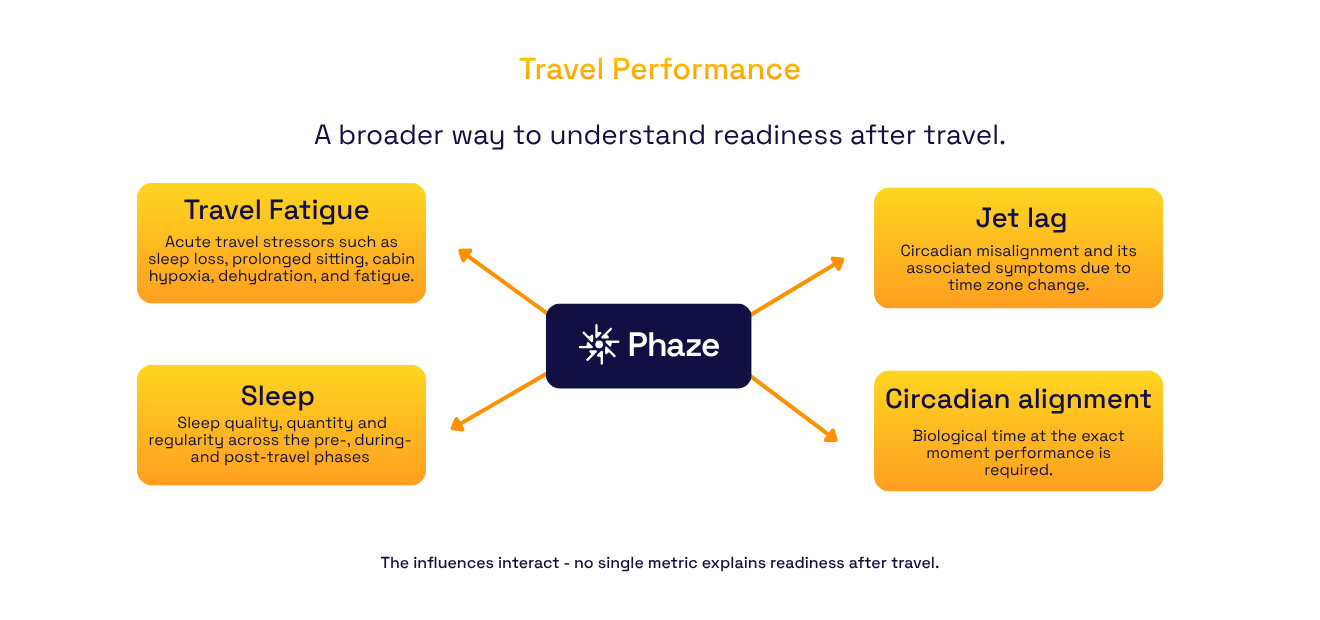
These areas overlap, but each asks a different question. A plan might preserve a favourable biological game time while the flight reduces sleep. An early arrival might provide time to recover from the journey while exposing athletes to a difficult period of circadian adjustment. The best balance depends on the individual, the journey and the timing and demands of the event.
The Melbourne game brought welcome attention to biological performance time. It should also prompt us to ask what condition athletes are in when that moment arrives.
At Phaze, we work to bring those four considerations together, helping teams and travellers plan around the moments when they need to perform.
You can minimise the body-clock shift, but you cannot remove the journey.