
In elite sport, travel is often treated as a logistics problem: book the flights, organise the transfers and arrive with enough time to prepare.
But teams experience something more complex. Travel can affect readiness, recovery and behaviour—altering how athletes sleep, feel, think and perform before, during and after a journey.
An athlete can cross several time zones, report relatively mild jet-lag symptoms and still underperform. Another can complete a long journey with little or no time-zone change and arrive fatigued, cognitively slower and less reactive. An athlete may even obtain eight hours of sleep yet still be required to compete at an unfavourable point in their biological day.
Teams compete on local time. Athletes perform on biological time.
This principle has always sat at the heart of Phaze. Our work has focused on helping athletes manage jet lag, travel fatigue, sleep and circadian disruption around the moment they need to perform. Travel Performance is an evolution of that story: a practical way of bringing those interconnected factors together and applying them to the outcome that matters most, readiness at the key performance time.
Travel Performance is not proposed as a validated scientific framework. It is a practical performance lens, grounded in established research, that helps teams consider the combined influence of several factors without diminishing the importance of jet lag or travel fatigue.
Jet lag matters, but it does not explain every travel effect
Jet lag occurs when the internal body clock is misaligned with the time at a new destination following rapid travel across time zones. It can disturb sleep, alertness, mood, gastrointestinal function and physical or cognitive performance.
However, not every travel-related problem is caused by jet lag.
Travel fatigue is the burden created by the journey itself. Prolonged sitting, the hypoxic environment of the aircraft cabin, restricted movement, limited sleep opportunities, unfamiliar meals, dehydration, stress and disruption to normal routines can affect an athlete even when few, or no, time zones are crossed.
In professional rugby players, a 14-hour journey across only one time zone was followed by slower psychomotor-vigilance responses and temporary reductions in multi-rebound and drop-jump performance (1). With little circadian displacement, these findings are more consistent with acute travel fatigue than conventional jet lag.
What this means for teams
A journey does not need to cross several time zones to influence readiness. Travel plans should account for the burden of the journey itself, including its timing, duration, sleep opportunity, movement restrictions and disruption to athletes’ normal routines.
Travel can affect different parts of performance at different rates
Fabunmi and colleagues reviewed the effects of travel fatigue and jet lag on athletes’ sleep and performance (2). The findings varied between studies, athletes and performance measures, but several applied patterns emerged.
Sleep was commonly disrupted during travel and in the first days after arrival. Reported changes included total sleep time, time in bed, sleep efficiency and sleep-onset latency. In one group of elite track cyclists, sleep efficiency fell to 59.8% during eastward travel and remained reduced during the first 48 hours after arrival (3).
Cognitive and subjective outcomes were also affected. Studies reported changes in alertness, psychomotor vigilance, fatigue, stress, mood and mental readiness. In the professional rugby study, the slowest reaction-time responses were approximately 7% slower on arrival than at baseline (1).
The physical findings were more nuanced. Countermovement-jump performance was frequently maintained or even improved, while repeated-rebound jumps, drop-jump measures and sprint performance showed greater evidence of temporary disruption. An athlete may therefore preserve one expression of performance while sleep, cognition, repeated-effort capacity or subjective readiness remains compromised.
What this means for teams
No single test can provide a complete picture of post-travel readiness. Monitoring should reflect the demands of the sport and the athlete’s role, combining relevant measures of sleep, fatigue, cognition, mood and physical performance rather than relying on one headline metric.
Sleep is central, but duration is only part of the picture
Sleep is fundamental to recovery and performance. A systematic review by Thun and colleagues found that sleep deprivation was negatively associated with athletic performance, while sleep extension appeared to improve it (4).
Travel can reduce sleep opportunity during the journey, delay sleep onset, fragment sleep and disturb its timing after arrival. Each of these effects can increase fatigue and reduce physical or cognitive readiness.
However, sleep duration alone cannot explain readiness after travel.
Sleep is regulated by both homeostatic pressure, the need for sleep that builds with time awake, and the circadian system, which influences when the body is biologically prepared to sleep or remain alert (4). Two athletes can each obtain eight hours of sleep but experience different levels of readiness if that sleep occurred at different biological times.
The key questions are therefore not only, “How long did they sleep?” and “How well did they sleep?” but also, “When did they sleep relative to their body clock?” and “Where will that body clock be when they need to perform?”
What this means for teams
Protecting sleep should remain a priority, but sleep advice must be timed in context. Poorly timed sleep or naps may support short-term recovery while making circadian adaptation more difficult. Sleep planning should therefore reflect the journey, the athlete’s current biological time and the target performance window.
Performance has a biological clock
Athletic performance is not constant across the day, and different abilities do not necessarily peak at the same time. Research discussed by Drust and Ayala shows that time-of-day effects vary according to the athlete, the task and the component of performance being measured (6,7).
Atkinson and colleagues found that trained cyclists completed a 16.1-km time trial approximately 3.5% faster at 17:30 than at 07:30. A 25-minute warm-up improved performance at both times but did not remove the morning deficit, even among cyclists who tended towards morningness (8).
In tennis, Atkinson and Speirs reported first-serve velocity to be around 3.7% lower at 09:00 than at 18:00, while serve accuracy followed a different daily pattern (9). Speed, accuracy, endurance, decision-making and other performance components may therefore each have a different optimal window.
Core body temperature is a well-established indirect marker of circadian timing. It typically peaks in the late afternoon, broadly coinciding with higher levels of speed, agility, jumping power and force production (6). However, temperature alone does not fully explain these time-of-day effects. Pullinger and colleagues found that repeated-sprint distance, average power and average velocity were approximately 7.8–8.3% lower in the morning. Raising morning body temperature to evening, or conventionally “optimal” levels did not restore performance to evening values (10). This suggests that performance may be influenced by the athlete’s underlying circadian phase and its alignment with the performance time, rather than by physical body temperature alone.
Chronotype adds another layer. Facer-Childs and Brandstaetter observed daily performance variation of around 7–10% in early and intermediate circadian types, but as much as 26% in late types (11). Time elapsed since habitual awakening was a stronger predictor of peak performance than clock time alone (11). Two athletes competing at 10:00 may therefore be performing at very different points in their biological day.
These findings do not mean that athletes always perform best in the evening. Fine motor control and accuracy can follow different rhythms, while sleep, meals, habitual training time, motivation and environmental conditions can amplify, reduce or mask circadian effects (7).
After travel, the local start time tells only half the story. A match may begin at 19:00 local time while an athlete’s circadian system remains much closer to home time. The applied question is not simply when the event starts, but what biological time that moment represents for each athlete.
What this means for teams
Planning should start with the key training session, match or race time and work backwards. Teams should estimate where athletes’ body clocks are likely to be at that moment, consider individual chronotype and habitual wake time, and use appropriately timed light, sleep, caffeine, meals and activity to support the required performance window.
A practical Travel Performance approach
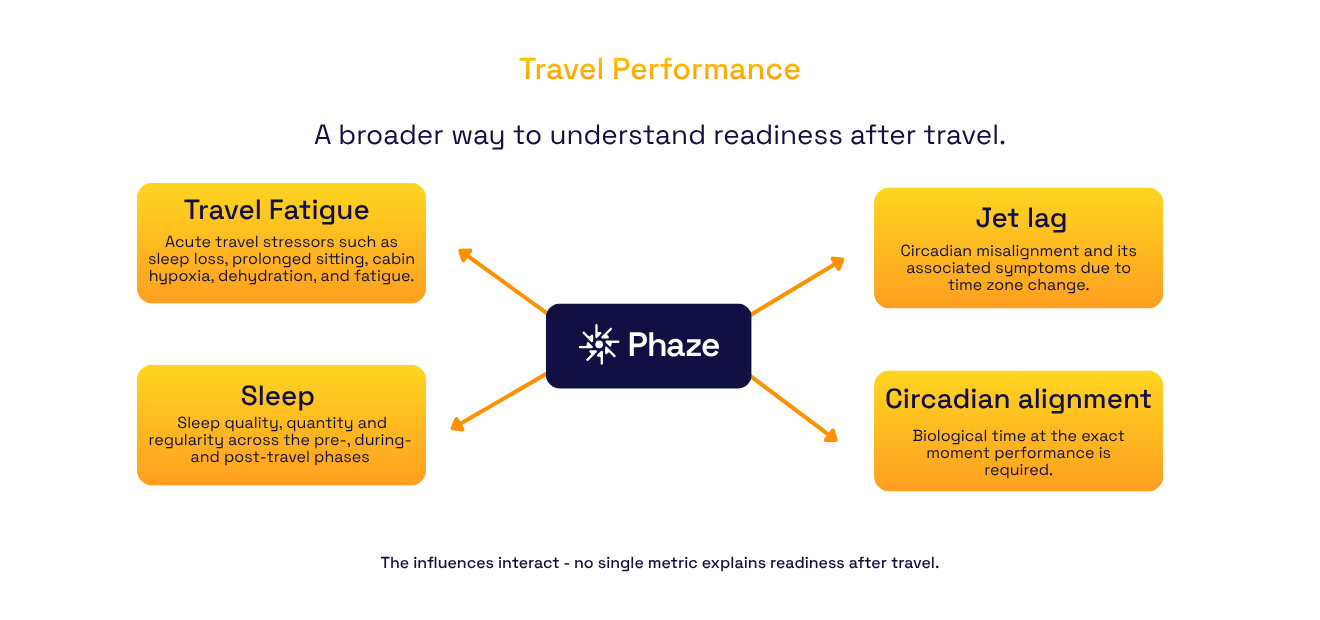
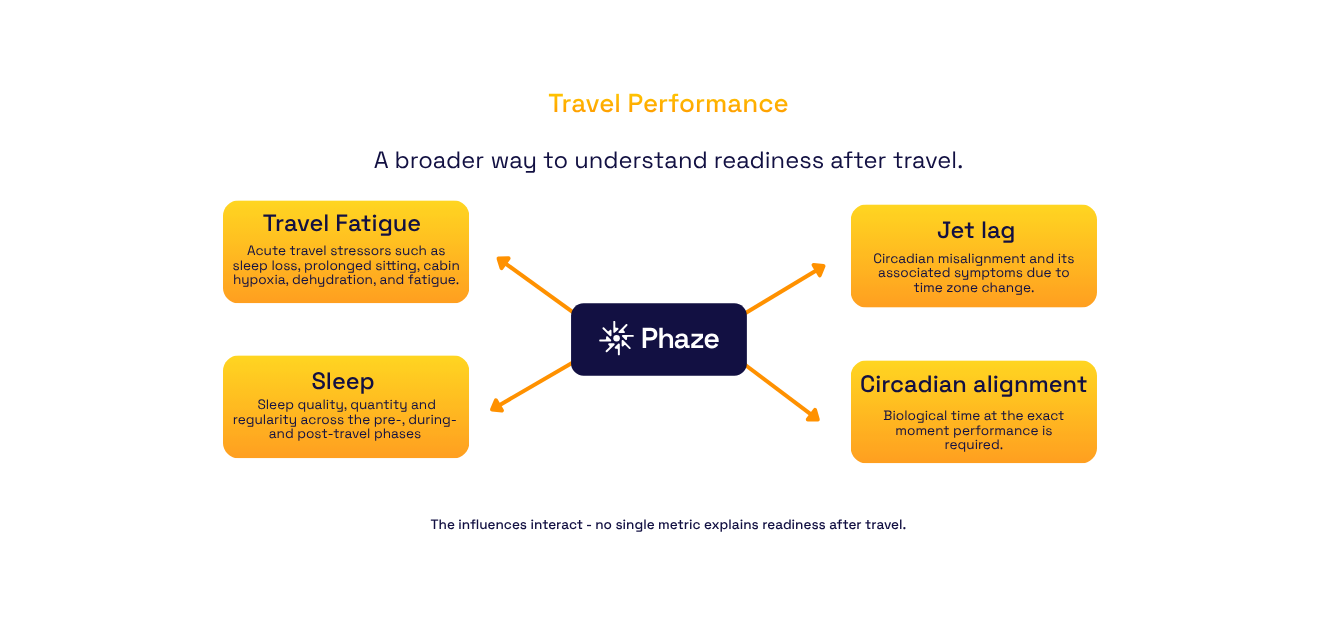
Travel Performance brings four interacting influences together:
1. Travel fatigue
What burden has the journey itself created? This includes journey duration, timing, sleep opportunity, seating, movement, nutrition, hydration, stress and disruption to normal routines.
2. Jet lag
How far is the athlete’s circadian system misaligned with the destination, and what symptoms are they experiencing as a result?
3. Sleep
How much sleep has the athlete obtained, how good was it and—critically—when did it occur?
4. Performance-time alignment
Where will the athlete’s biological clock be at the exact time of the key training session, match, race or decision?
These factors do not operate independently. Travel fatigue can reduce sleep. Circadian misalignment can disturb both sleep and alertness. Poorly timed sleep, light, meals, caffeine and exercise can delay adaptation. Their relative importance also changes according to the journey, the athlete and the task ahead.
This means the objective should not always be to adjust fully to destination time as quickly as possible. For a short trip, maintaining partial alignment with home time may better support the competition and return journey. For a longer stay, shifting towards local time may be more appropriate. If an event occurs soon after arrival, or at an unusual local time, the best strategy may be to align specifically with that performance window.
What this changes for teams
A Travel Performance approach starts with the event and works backwards. Practitioners should ask:
- When does the athlete actually need to perform?
- Are time zones being crossed, and in which direction?
- What biological time will the key performance moment represent?
- How do chronotype and habitual sleep-wake timing affect the individual response?
- How much circadian adaptation is both possible and desirable?
- What burden will the journey itself create?
- How can sleep be protected without reinforcing an unhelpful circadian schedule?
- Which behaviours—particularly light, sleep, caffeine, meals and activity—should be timed differently?
- Which readiness outcomes are most relevant to the sport and the athlete’s role?
- What happens after the event, including the return journey and next performance demand?
This changes travel planning from a generic destination-based process into an individual, event-led performance strategy.
From arriving to performing
Phaze has always been built around the interaction between travel, circadian timing, sleep and performance. Travel Performance gives that approach a clear and practical structure.
Rather than preparing athletes simply to arrive at a destination or follow generic travel advice, Phaze creates personalised guidance around the time they actually need to perform. Sleep, light exposure, caffeine, activity and other behaviours can then be timed around the journey, the individual and the target performance window.
Jet lag remains important. Travel fatigue remains important. So do sleep, recovery and circadian alignment. Travel Performance brings them together so teams can understand which factors matter most for a particular athlete, journey and event.
The objective is not merely to arrive, adjust or feel recovered. It is to give athletes the best possible opportunity to perform the task that matters, at the time it matters.
That is Travel Performance.
References
- Uchiyama K, Peeling P, Halson SL, et al. Immediate effects of overnight long-haul travel on physical and cognitive performance and sleep in professional male rugby union players (a 2-part study). International Journal of Sports Physiology and Performance. 2025. https://doi.org/10.1123/ijspp.2024-0328
- Fabunmi OA, Jansen van Rensburg A, Vitale JA, et al. Unpacking the impact of travel and jet lag on sleep and performance of athletes: a narrative review. Current Sleep Medicine Reports. 2026;12:18. https://doi.org/10.1007/s40675-026-00355-1
- Doherty R, Madigan SM, Nevill A, Warrington G, Ellis JG. The impact of long-haul travel on the sleep of elite athletes. Neurobiology of Sleep and Circadian Rhythms. 2023;15:100102. https://doi.org/10.1016/j.nbscr.2023.100102
- Thun E, Bjorvatn B, Flo E, Harris A, Pallesen S. Sleep, circadian rhythms, and athletic performance. Sleep Medicine Reviews. 2015;23:1–9. https://doi.org/10.1016/j.smrv.2014.11.003
- Augsburger GR, Sobolewski EJ, Escalante G, Graybeal AJ. Circadian regulation for optimizing sport and exercise performance. Clocks & Sleep. 2025;7(2):18. https://doi.org/10.3390/clockssleep7020018
- Ayala V, Martínez-Bebia M, Latorre JA, et al. Influence of circadian rhythms on sports performance. Chronobiology International. 2021;38(11):1522–1536. https://doi.org/10.1080/07420528.2021.1933003
- Drust B, Waterhouse J, Atkinson G, Edwards B, Reilly T. Circadian rhythms in sports performance—an update. Chronobiology International. 2005;22(1):21–44. https://doi.org/10.1081/CBI-200041039
- Atkinson G, Todd C, Reilly T, Waterhouse J. Diurnal variation in cycling performance: influence of warm-up. Journal of Sports Sciences. 2005;23(3):321–329. https://doi.org/10.1080/02640410410001729919
- Atkinson G, Speirs L. Diurnal variation in tennis service. Perceptual and Motor Skills. 1998;86(3 Pt 2):1335–1338. https://doi.org/10.2466/pms.1998.86.3c.1335
- Pullinger SA, Oksa J, Clark LF, et al. Diurnal variation in repeated sprint performance cannot be offset when rectal and muscle temperatures are at optimal levels (38.5°C). Chronobiology International. 2018;35(8):1054–1065. https://doi.org/10.1080/07420528.2018.1454938
- Facer-Childs ER, Brandstaetter R. The impact of circadian phenotype and time since awakening on diurnal performance in athletes. Current Biology. 2015;25(4):518–522. https://doi.org/10.1016/j.cub.2014.12.036