
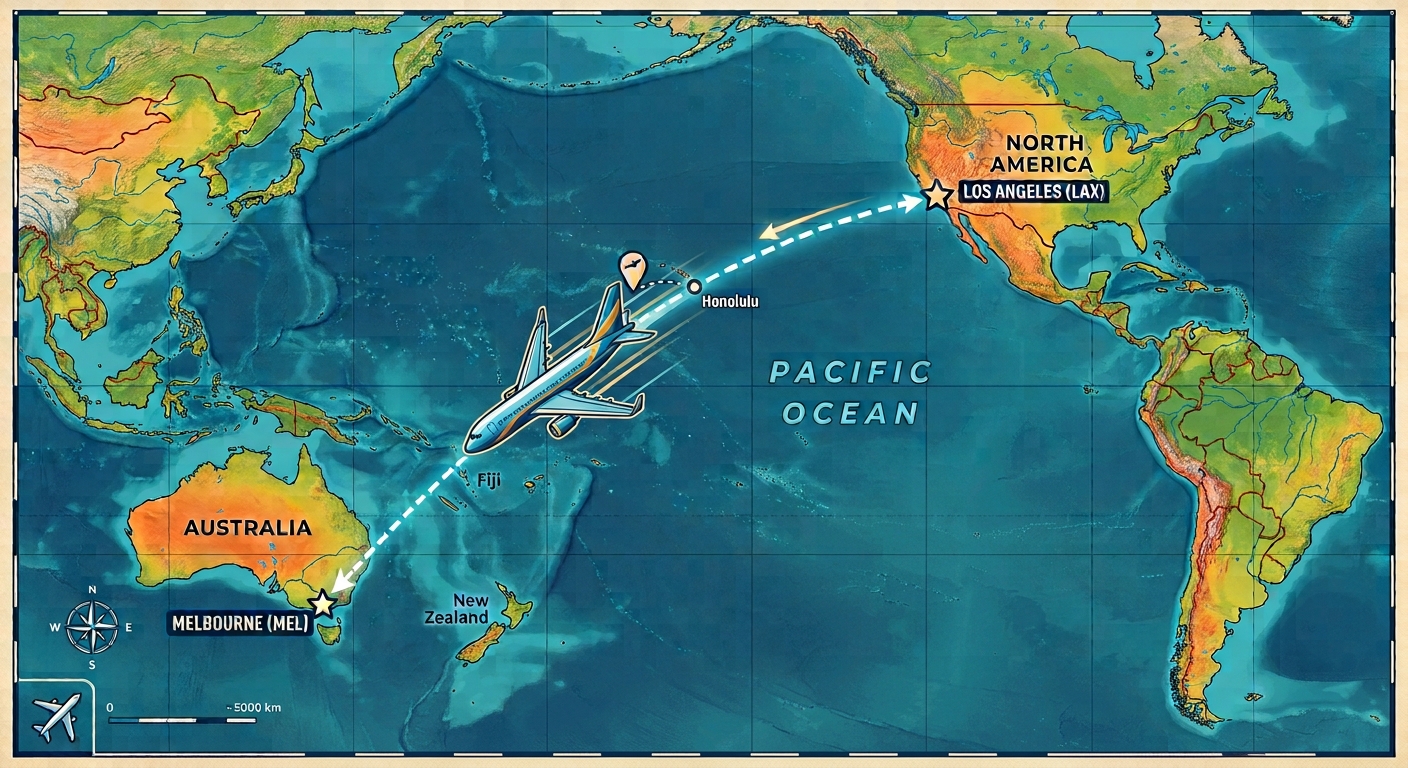
The San Francisco 49ers and Los Angeles Rams have taken two very different approaches to preparing for the NFL’s first regular-season game in Melbourne.
The 49ers arrived more than a week before the game, giving themselves time to recover and adapt to Melbourne. The Rams have travelled much later, leaving only a few days between arrival and kick-off.
So, who has made the better decision?
At first glance, the science appears to favour the 49ers. Arriving early is the conventional recommendation when travelling across multiple time zones: recover from the flight, start living on local time, and let the body clock adjust before competition.
However, this journey is more nuanced than simply counting time zones.
Melbourne is 17 hours ahead, but the body clock does not shift by 17 hours
We wrote about this previously here.
Although Melbourne is 17 hours ahead of California, the body clock can reach the same local schedule by delaying (shifting later) by approximately seven hours. That is still a substantial adjustment, but it is very different from asking the body to advance by 17 hours.
The direction matters because our circadian system generally finds delaying easier than advancing. The literature is somewhat conflicting, but as a rule of thumb, you can expect a best-case body clock adjustment of 1.5 to 2 time zones per day when travelling west. With it generally more difficult to shift eastwards, with an adjustment rate of 1 time zone per day (1,2). Meaning, on paper, the 49ers could be fully acclimatised to local time a few days before game day.
This gives the 49ers a realistic opportunity to progressively shift towards Melbourne time during their longer stay.
The game kicks off at 10:35am in Melbourne, equivalent to 5:35pm in California. Biologically, that is a very familiar time for NFL players to perform. It creates the possibility that a team could remain closer to Pacific time and still be well positioned for the game itself.
This is where the two strategies begin to look less like right versus wrong and more like two different bets.
What might the Rams experience immediately after travelling?
A recent study of professional rugby players provides perhaps the closest comparison to the physical and cognitive demands of the NFL. Following overnight long-haul travel, players recorded reaction times that were 7% slower immediately after arrival. Repeated-jump flight time also fell by 46% on the first day post-travel and remained below baseline in the days following travel in the physical component of the research (3). The researchers suggested that the reduction in repeated-jump performance could reflect changes in muscular elasticity or neural control.
That distinction matters in the NFL. Performance is not one isolated sprint or jump. It is the repeated ability to read a situation, react quickly, tolerate contact and reproduce explosive actions across a game.
These findings favour the 49ers. If the Rams arrive with residual sleep loss and travel fatigue, even a well-timed body clock may not fully protect their readiness.
The quality of the travel plan may matter more than the number of days
Arriving late does not necessarily mean doing nothing. With fewer days available, the detail of the Rams’ strategy becomes more important.
In one study, physically trained men completed 21 hours of eastward travel across eight time zones. One group followed a targeted light-exposure and sleep-hygiene strategy, while the other maintained its normal behaviour (4).
The intervention group obtained more sleep during the journey and across the four nights after arrival. They also performed better in 5m and 20m sprint tests, with sprint performance returning to baseline approximately 24 hours earlier. Jump power, mood and motivation were also better protected, although intermittent-sprint performance did not improve.
The benefits were not only physical. Across the four days after travel, athletes who did not follow the targeted light and sleep strategy also reported worse mood and motivation. That matters in the NFL, where performance depends on concentration, communication and making accurate decisions under pressure, not simply speed and power.
This study, while an isolated investigation, shows that light and sleep are not simply wellness add-ons. Used at the right times, they can influence qualities directly relevant to team-sport performance.
For the Rams, every decision about when players sleep, seek light, avoid light, eat, and train could determine whether their late-arrival strategy succeeds, and perhaps, unlike in the Rugby study, they can negate some of that impact.
Sleeping on the plane and the effects on recovery
The Rams’ approach may depend heavily on players obtaining meaningful sleep during the flight. That is easy to plan on paper and much harder to achieve in the air.
Canadian short-track speed skaters travelling across approximately 13 time zones averaged 6 hours 16 minutes of sleep during travel, compared with 7 hours 8 minutes at baseline, a reduction of 52 minutes (5). After arrival, their sleep progressively increased for five days as they recovered the accumulated sleep debt and adjusted their sleep-wake patterns. Encouragingly, their neuromuscular performance and results in competition were not impaired. However, they travelled approximately a week before racing.
That makes their outcome reassuring for the 49ers, but less directly reassuring for the Rams. The skaters demonstrated that elite athletes can absorb a major journey without a measurable competitive decline, but they also had time to recover the sleep they lost.
In the Rugby study, total sleep time fell by 19% when travelling to the game, but with no recorded loss on the return leg. However, sleep time then dropped by 49% (to 3hr 40 min) once back home. Indicating the impact of an unadjusted body clock and that many variables influence sleep on and following travel.
Other research shows how variable these responses can be. Soccer players travelling across seven time zones recorded reduced sleep and greater fatigue during the first two days after arrival (6). Conversely, elite cricketers travelling in business class preserved sleep relatively well and reported limited jet-lag symptoms, highlighting how flight conditions, previous experience and journey planning can change the outcome (7).
The Rams are therefore banking on more than simply sleeping on the plane. They are banking on the timing, duration and quality of that sleep being good enough to reduce travel fatigue without inadvertently shifting the body clock away from their intended position.
Should athletes fully adapt to local time or remain on California time?
The 49ers’ longer stay should allow them to sleep, train and recover more comfortably on Melbourne time. It also reduces the risk of arriving with the immediate reaction-time and neuromuscular impairments observed in the rugby research.
The trade-off is that greater adaptation may move their biological performance window away from the familiar 5:35pm California time represented by kick-off.
The Rams may accept more immediate travel fatigue in exchange for less circadian adaptation. If they can remain sufficiently close to California time, 10:35am in Melbourne could still feel like late afternoon.
But maintaining California time in Melbourne is not as simple as refusing to change a watch. The local light-dark cycle strongly influences the body clock. Team meetings, training, meals and media obligations are all likely to happen at local time. Players must also be awake, fuelled and ready to begin their match-day routine early in the Melbourne morning.
Light timing will be crucial; understanding the variance between players’ preferred bedtimes will matter too, and it’s hard to manage across a 50+ player team. The Rams may therefore need a compromise: enough local adjustment to function and sleep, but not so much that they lose the biological advantage created by the kick-off time.
Game 1 is not worth more than Game 2
In the NFL, no win is more important than another. Rivalries and big games like this one may put a bigger spotlight on the game, but a win or loss still matters the same to each team.
Both teams then return to California with little more than a week before playing again. The Melbourne game is not worth any more than the next one.
If the 49ers have substantially adapted to Melbourne, they must shift back towards California after returning home. That requires an eastward phase advance, which is typically more difficult than delaying the body clock. In a study we reviewed here, which looked at over 3,000 WNBA games, jet lag even just across the US impacted results. When teams played at home with estimated eastward jet lag, their average points differential was on average +0.69, compared with +2.55 when no jet lag was estimated. That represents a difference of 1.86 points per game. Effectively, their home advantage was almost wiped out.
Research involving elite international footballers supports this concern. Across 355 trips, sleep ratings were poorer following eastward than westward travel, while journeys crossing nine or more time zones produced worse fatigue, sleep and overall wellness during the first two days after arrival (8). Separate work with international footballers also found poorer perceptual responses when players travelled back from national-team duty to their clubs, suggesting that the return journey can be its own performance problem (9).
The Rams may therefore face greater travel fatigue before Game 1 but less circadian readjustment before Game 2. For the 49ers, the balance could be reversed: better recovered in Melbourne, but potentially more work to do after returning home.
Of course, both teams have more than a standard NFL week before their second fixture. That helps. But the return flight, accumulated sleep disruption and direction of the required shift mean those additional days should not automatically be treated as full recovery days.
So, which travel strategy is best for the NFL in Melbourne?
Going early follows the conventional science. It provides more time to recover from the flight, restore sleep and progressively adapt to the destination. On that basis, the 49ers have reduced several obvious risks.
Going late is the more aggressive strategy, but the 10:35 am kick-off makes it scientifically plausible. If the Rams can preserve something close to California time while getting enough sleep and managing travel fatigue, they may arrive biologically ready to perform and potentially face less circadian disruption on their return.
The answer lies in details we cannot see from an arrival date:
- When did the players sleep during the flight?
- When are they seeking or avoiding light?
- Have they accounted for chronotype and different bed and wake time preferences?
- Are they adapting to Melbourne or deliberately preserving Pacific time?
- How are training, meals and recovery timed?
- How much adaptation will they need to reverse after returning home?
- Is the strategy designed for one game, or both?
Will the winner tell us who planned best? Sadly, for me, probably not. The better team will likely still win.
But as that WNBA study shows us, if the game comes down to one late decision, one slow reaction or one repeated explosive effort, the small details of each travel strategy may influence the scoreboard.
The travel battle may not be won by the team that arrived first. It may be won by the team whose strategy best aligns sleep, light, recovery and biological time with both moments of performance.
References
1. https://pubmed.ncbi.nlm.nih.
2. https://pubmed.ncbi.nlm.
3. doi: 10.1123/ijspp.2024-0328
4. https://pubmed.ncbi.nlm.nih.
5. https://pubmed.ncbi.nlm.nih.
6. https://pubmed.ncbi.nlm.nih.
7. https://pubmed.ncbi.nlm.nih.