
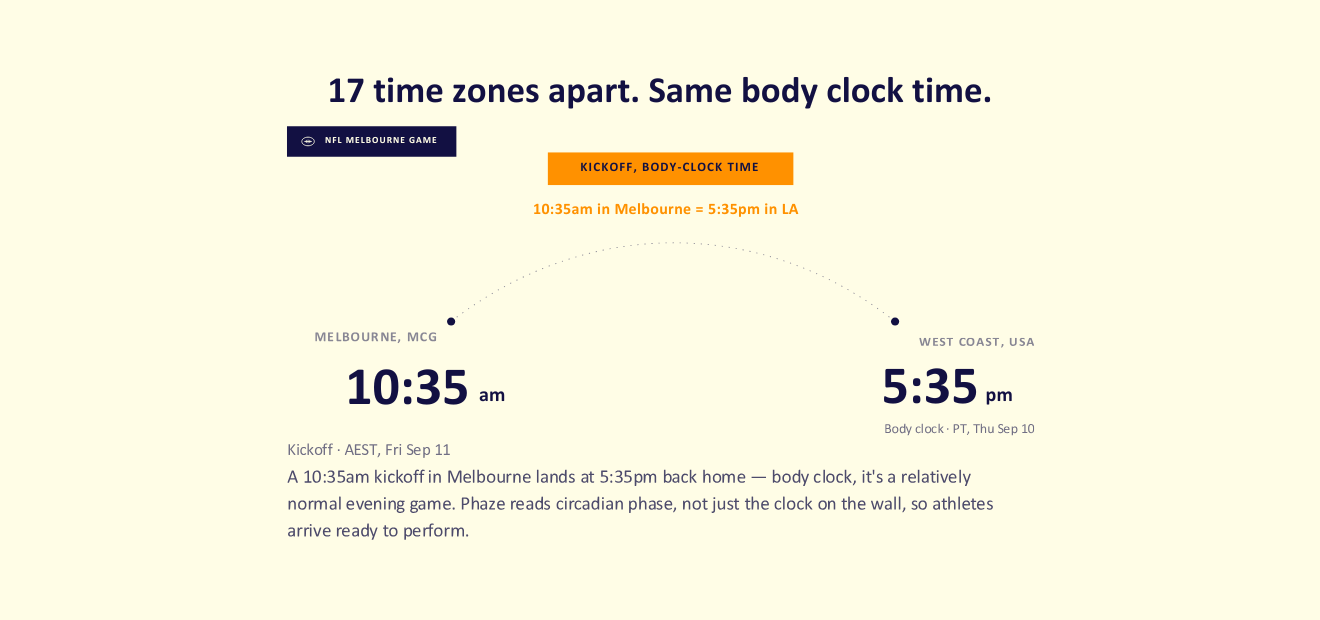
Melbourne may be 17 hours ahead of the US West Coast, but biologically, that does not necessarily mean a 17-hour shift.
Because the body clock operates on a 24-hour cycle, Melbourne can also be viewed as seven hours behind. The challenge for the West Coast teams playing the NFL’s first game in Melbourne is therefore closer to managing a seven-hour circadian delay on the way out, and a seven-hour advance on the return.
But there is another important detail: game time.
A morning kick-off in Melbourne will occur at almost the same biological time as a typical evening game on the West Coast. In fact, West Coast teams can experience a greater difference in their biological performance time when playing midday games in the Central or Eastern time zones.
So, the objective may not be to fully adjust every player to Melbourne time.
Instead, the challenge is to develop a plan that allows players to maintain a relatively consistent biological game time from one week to the next, while living, training and recovering under Melbourne’s completely different light-dark cycle.
That introduces some important questions:
- How much should players adjust before travelling?
- How should sleep, light exposure, caffeine and training be timed in Melbourne?
- How do you protect recovery when the local daytime conflicts with the body’s biological night?
- And how do you prepare players for the return journey and the following fixture?
This is why travel planning cannot be based on the number of time zones crossed alone.
The destination matters, but so does the timing of performance.
For these West Coast teams, fully adapting to Melbourne time may not necessarily be the goal. The greater challenge may be finding the right amount of adaptation: enough to sleep, recover and train effectively in Melbourne, without unnecessarily shifting the biological timing of performance.
And that strategy cannot stop at kick-off. How players adapt in Melbourne will influence the circadian challenge they face when they return home.
Teams compete on local time. Athletes perform on biological time.
For a trip as unusual as Melbourne, understanding the difference between the two could be an important part of preparing to perform.
References
- Uchiyama K, Peeling P, Halson SL, et al. Immediate effects of overnight long-haul travel on physical and cognitive performance and sleep in professional male rugby union players (a 2-part study). International Journal of Sports Physiology and Performance. 2025. https://doi.org/10.1123/ijspp.2024-0328
- Fabunmi OA, Jansen van Rensburg A, Vitale JA, et al. Unpacking the impact of travel and jet lag on sleep and performance of athletes: a narrative review. Current Sleep Medicine Reports. 2026;12:18. https://doi.org/10.1007/s40675-026-00355-1
- Doherty R, Madigan SM, Nevill A, Warrington G, Ellis JG. The impact of long-haul travel on the sleep of elite athletes. Neurobiology of Sleep and Circadian Rhythms. 2023;15:100102. https://doi.org/10.1016/j.nbscr.2023.100102
- Thun E, Bjorvatn B, Flo E, Harris A, Pallesen S. Sleep, circadian rhythms, and athletic performance. Sleep Medicine Reviews. 2015;23:1–9. https://doi.org/10.1016/j.smrv.2014.11.003
- Augsburger GR, Sobolewski EJ, Escalante G, Graybeal AJ. Circadian regulation for optimizing sport and exercise performance. Clocks & Sleep. 2025;7(2):18. https://doi.org/10.3390/clockssleep7020018
- Ayala V, Martínez-Bebia M, Latorre JA, et al. Influence of circadian rhythms on sports performance. Chronobiology International. 2021;38(11):1522–1536. https://doi.org/10.1080/07420528.2021.1933003
- Drust B, Waterhouse J, Atkinson G, Edwards B, Reilly T. Circadian rhythms in sports performance—an update. Chronobiology International. 2005;22(1):21–44. https://doi.org/10.1081/CBI-200041039
- Atkinson G, Todd C, Reilly T, Waterhouse J. Diurnal variation in cycling performance: influence of warm-up. Journal of Sports Sciences. 2005;23(3):321–329. https://doi.org/10.1080/02640410410001729919
- Atkinson G, Speirs L. Diurnal variation in tennis service. Perceptual and Motor Skills. 1998;86(3 Pt 2):1335–1338. https://doi.org/10.2466/pms.1998.86.3c.1335
- Pullinger SA, Oksa J, Clark LF, et al. Diurnal variation in repeated sprint performance cannot be offset when rectal and muscle temperatures are at optimal levels (38.5°C). Chronobiology International. 2018;35(8):1054–1065. https://doi.org/10.1080/07420528.2018.1454938
- Facer-Childs ER, Brandstaetter R. The impact of circadian phenotype and time since awakening on diurnal performance in athletes. Current Biology. 2015;25(4):518–522. https://doi.org/10.1016/j.cub.2014.12.036