
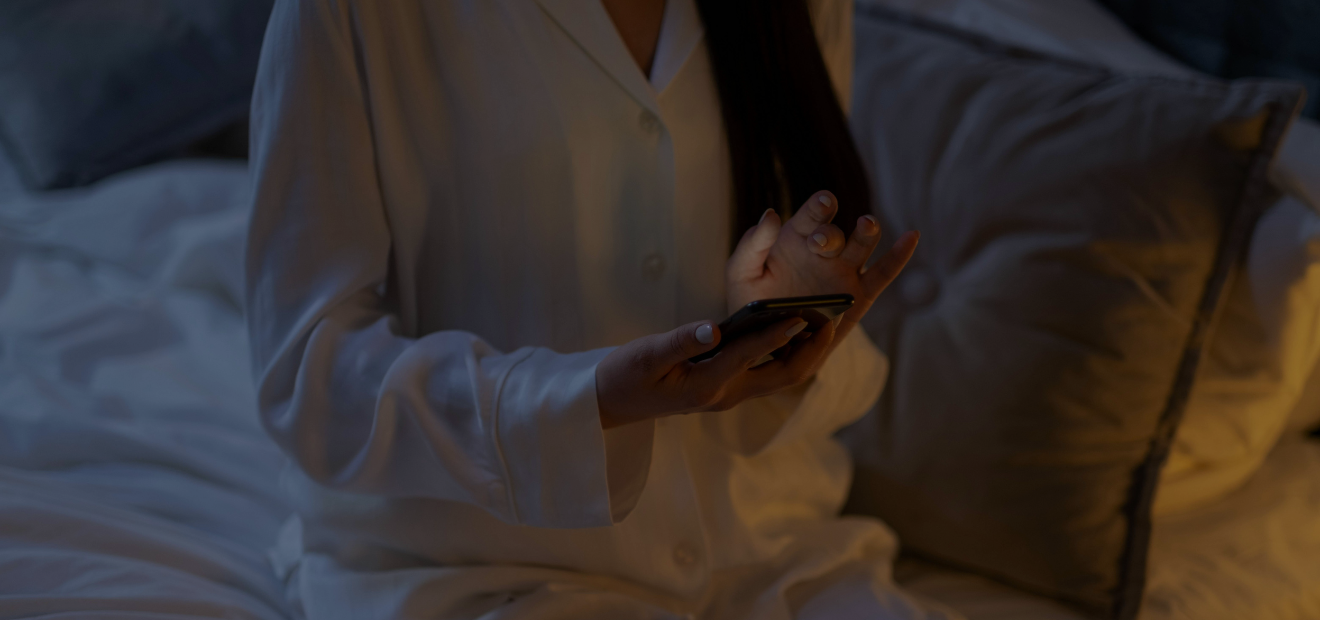
Blue light has become one of the most widely discussed topics in sleep science.
Phones, tablets, laptops and LED lighting are often blamed for delayed sleep onset, poor sleep quality and disrupted circadian rhythms. While there is evidence that short-wavelength (blue) light can influence the body clock (1;2), this relationship is more nuanced than often appreciated. Blue light can affect circadian timing, but the size of that effect depends heavily on intensity, timing, duration, and other factors surrounding sleep (3).
Why blue light matters
Circadian rhythms are highly sensitive to light. When we are exposed to it, melatonin (a hormone which acts as a marker of darkness or nighttime in our body) is suppressed. Exposure to bright light late in the evening can delay internal timing and shift sleep later (4:5). However, not all light is equal; short-wavelength light in the blue spectrum, such as that emitted from smartphones, has a greater impact on our body clock than other types of light (6).
Screen light is not the same as bright light therapy
A common misunderstanding is assuming all blue light exposure produces the same effect.
Controlled laboratory studies often use light intensities far greater than those produced by personal devices during normal evening use. One widely cited study found that evening use of an iPad for reading delayed melatonin timing, reduced evening sleepiness and impaired next-morning alertness compared with reading a printed book (7). However, other research has found smaller effects under more typical real-world exposure conditions. Heath et al. (2014; 8) found that tablet screen exposure before bed did not significantly alter sleep onset. Factors such as brightness, viewing distance, ambient lighting, and exposure timing and duration may all influence whether screen use will impact one’s sleep.
Why is blue light often blamed too quickly
Blue light is an easy scapegoat as it is very visual. However, evening technology use may also lead to sleep problems for reasons beyond light.
Sleep onset is also strongly influenced by:
• mental stimulation
• emotional arousal
• stress
• bedtime delay
• irregular sleep timing
The content being consumed or the activity undertaken often matters as much as the light itself. This has been particularly interesting in research exploring pre-sleep media use, where even activities such as video gaming have sometimes shown smaller effects on sleep than many might expect (9).
A bright screen used briefly for passive reading is very different from prolonged social media use, emotionally stimulating content, work emails, or late-night decision-making.
Why the nervous system state matters before bed
Reducing blue light does not automatically guarantee better sleep if the nervous system remains highly stimulated.
Even with reduced screen brightness or blue-light filters, elevated sympathetic activation can delay sleep onset and reduce sleep quality.
This is why pre-sleep routines that lower arousal often matters just as much as light management.
Breathing work, lower stimulation, reduced task engagement, and clear transitions away from work all help create conditions in which light reduction becomes more meaningful.
Are blue light filters useful?
Blue light filters and warmer screen tones can still help some individuals.
They often reduce visual intensity, making evening device use feel less stimulating.
But filters should not be treated as a complete solution.
A filtered screen used for another hour of stimulating activity still extends wakefulness and delays sleep behaviourally.
When light exposure matters most
The strongest circadian effects tend to occur when light exposure is:
• bright
• prolonged
• close to habitual bedtime
• repeated over multiple evenings
• occurring during circadian-sensitive periods
This becomes especially relevant when someone is already managing jet lag, shift work, delayed sleep timing or travel fatigue.
In these cases, light timing becomes a meaningful performance variable.
Why this matters even more during circadian shifting
The role of light becomes much more important when crossing time zones or changing habitual sleep and performance times. Jet lag, shift work disorder and social jet lag all occur because the internal circadian clock does not align with the individual’s desired (or required) work or training schedule, or the external light-dark cycle. The body therefore releases melatonin, regulates alertness, and drives sleep at non-desirable times, creating temporary circadian misalignment (10).
This is where timed light exposure becomes one of the most effective non-pharmacological tools available.
Appropriately timed light exposure can shift the circadian clock earlier or later depending on when it is delivered. Morning light exposure after eastward travel generally helps advance circadian timing, while evening light exposure after westward travel helps delay it (12); both of which push the individual toward more closely aligning with the time zone of the destination.
Importantly, the scientific literature shows that light intensity and timing often matter more than wavelength alone in real-world adaptation.
Although blue light is potent, studies comparing blue-enriched light with standard bright white light have shown that, at light intensities used in device aiming to impact circadian rhythms (such as light boxes), the ability to shift one’s body clock is similar between the two (11).
That is why in applied travel settings, measuring whether someone is receiving enough light at the right time can often be more important than focusing only on colour spectrum.
Even moderate light intensities can produce meaningful circadian shifts when timed correctly, particularly when exposure history and biological timing are considered (10).
Why Phaze focuses on light timing and intensity
This is why Phaze approaches light through timing and exposure guidance rather than simply labelling light as “good” or “bad”.
The Phaze light-scanning feature helps users understand whether their environment provides sufficient light intensity at the right time to support the desired circadian outcome.
Rather than focusing purely on wavelength, the feature helps athletes and staff assess whether light levels are high enough to stimulate alertness and circadian adaptation when needed, or low enough to protect melatonin when preparing for sleep.
This aligns closely with current circadian science, because real-world light responses depend on:
• timing
• intensity
• duration
• previous light exposure
• the individual’s biological timing
In practice, this means a bright hotel room, airport terminal, training facility or outdoor environment can all influence adaptation differently depending on when the exposure occurs.
For teams and travellers managing jet lag, that makes light one of the most controllable tools available.
The practical takeaway
For normal home sleep, blue light is often only one part of the story.
For jet lag, light becomes a strategic intervention.
Used correctly, it can accelerate adaptation, reduce circadian disruption and improve readiness during travel.
Used poorly, it can delay adaptation and prolong symptoms.
That is why timing matters more than simply avoiding screens.
Practical takeaways
A more useful strategy is:
• reduce screen brightness in the evening
• use warmer light settings where possible
• avoid stimulating content close to sleep
• maintain consistent sleep timing
• prioritise bright light exposure early in the day
• create a clear wind-down period before bed
Strong daytime light remains one of the most powerful anchors for circadian stability.
The bigger picture
Blue light matters, but rarely in isolation.
The most effective sleep strategies combine light management with behavioural habits, timing, routine and wider circadian awareness.
Because better sleep is rarely driven by one factor alone.
References and Further Reading
1. https://doi.org/10.1081/CBI-100107515
2. https://doi.org/10.1210/jc.2003-030570
3. https://doi/10.1073/pnas.1901824116
4. https://doi.org/10.1523/JNEUROSCI.21-16-06405.2001
5. https://doi.org/10.1210/jc.2003-030570
6. https://doi.org/10.1002/jbio.201900102
7. https://doi.org/10.1073/pnas.1418490112
8. https://doi.org/10.3109/07420528.2013.872121
9. https://doi.org/10.5935/1984-0063.20180046
10. https://doi.org/10.3389/fphys.2019.00927
11. https://doi.org/10.1016/j.sleep.2008.05.005
12. https://doi.org/10.1093/sleep/30.11.1460